Discussion summary

Screwworm control efforts faced delays and political disputes in 2023, with some attributing issues to funding cuts and cross-border challenges. Discussions included the potential of gene drives and ethical concerns about past research.

What the discussion says

  • Funding cuts and political disputes hinder screwworm control efforts.
  • Gene drives are considered a potential solution.
  • Ethical issues limit modern research methods.
Delays were caused by political disputes and funding issues.
natbobc
Gene drives could be a future solution.
Metacelsus

Comments

Hacker News

> (Some anti-screwworm efforts may have been hindered by DOGE, which cut APHIS staff, screwworm monitoring programs, and may have delayed funding for the Mexico facility, but it’s hard to be confident about this, and the administration has unsurprisingly rejected these claims.)

For an article that is so detailed in other areas, this feels like a very short dismissal of a topic that--regardless of direction--deserves more focus.

by Planktonne

DOGE probably didn’t help matters but the problem started to rise in 2023. My gut reaction was “damn that DOGE!” too but they didn’t start with cuts until 2025. So it likely just exasperated an already growing concern. This is the same kind of stuff anti-vaxers don’t get. We left South America out of the equation so when the circumstances of migration and feeding changed so did the status quo of a “screwworm free” line in the sand. Other peoples problems can quickly become everyone’s problem if left unchecked.

by natbobc

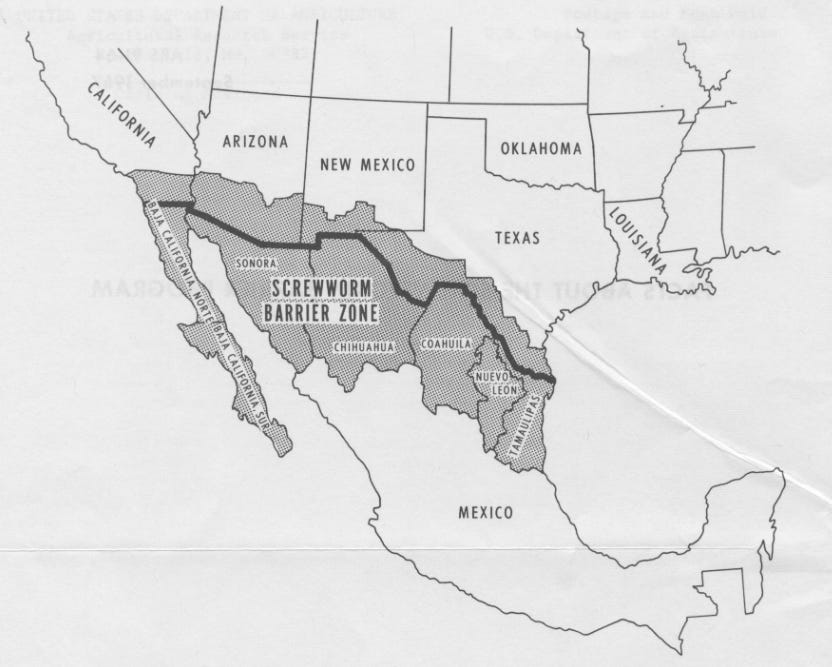
> And when it was clear that screwworms had breached the barrier, responses were sometimes delayed by political disputes — Mexico apparently initially made it very difficult for USDA screwworm flights to operate until the US Agricultural Secretary called to force the issue.

DOGE aside, as the article and commenters already mentioned that - if that giant buffoon Trump wouldn't have gone and screwed up relations with virtually every country south of the US sans Argentinia and El Salvador, including invading Venezuela to oust their president, maaaaybe other countries wouldn't find the risk of screwworm more acceptable than risking American government flights over their countries.

The damage the two Trump administrations caused will take decades to repair. And frankly if I were a country south of the US - I'd invest in my own resources to combat screwworms. There simply is no guarantee that, even if Trump fails and someone sane is elected in two years, they won't elect someone just as braindead in six years.

by mschuster91

You are blaming Trump for the failure of the Mexican government to act in its own self interest during the Biden administration?

by consensus1

Government solve problem. Problem gone. No more problem ever.

Problem come back? Because problem complex problem based on a large number of interdependent variables as is common is real life ecosystems? No way.

-Brought to you by grug gpt.

by troglodytetrain

Well that's nightmare fuel D:

by taco_emoji

Time to bring out the gene drives!

by Metacelsus

It sounds like the original research done 30s-50s would not be possible today. No one is getting an ethics approval for that. And "let me just get some cobalt-60" is probably also not happening

by yread

Current situation exist presisely due researches of 20th century though. This is largely connected things

by search_facility

Wow the thing that stood out to me was the number of Darien Gap crossing not being zero.

I was under the impression that was the most dangerous part of the planet for every possible reason.

The fact that it’s half a million a year is crazy!

Something must have changed in infrastructure for that to even be possible right?

by AndrewKemendo

It's a bit odd that the screwworm exists. Normally a parasite that kills its host is at an evolutionary disadvantage.

I wonder if the human practice of keeping large groups of livestock together in close proximity creates an unnatural "target rich environment" for the flies that they don't otherwise experience, making them much more of a problem.

by SoftTalker

Can't we just compare this to "wild" population?

by edoceo

Ungulates very often gather in large, close groups in nature, in order to defend themselves from predators, and to conserve heat during night time.

by nine_k

> The Southwest Animal Health Research Foundation (SWAHRF), an organization formed by a small group of Texas livestock producers… broke the logjam by raising millions of dollars in voluntary donations from Texas ranchers for screwworm eradication.

That can’t be right. The Texas Department of Agriculture published a piece titled “Dollars Don’t Kill Screwworms” just two years ago.

https://texasagriculture.gov/News-Events/Article/10239/OPINI...

> Listen, dollars don’t kill screwworms. Sterile flies do. Detection systems do. We already have the tools to manage this issue because we’ve been doing it successfully for decades.

See? We don't need big government programs to get this under control, we just need farmers to… I dunno… raise and breed their own own sterile flies, or buy them from Walmart.

by Eric_WVGG

I have a question for folks who have background in interventions like these.

Isn't there a risk that the artificially introduced reproductory pressures would select for screwworms that produce males that are resistant to radiation.

My chain of reasoning is that not all the of the irradiated males would be completely sterile. If so, then the next generation would be a mix of hatchlings of not radiated parents and those parents who have not been completely sterilized in spite of radiation -- thereby increasing the proportion of radiation resistant varieties, assuming resistance is an inheritable trait. These may then find themselves at the input side of sterile male generation factories.

The intervention obviously worked, but was that because steps were taken to counteract the possibility of raising radiation resistant varieties.

BTW the article was a great read.

by srean

I'd expect that if females start to breed more than once it would represent a problem. It's surprising it hasn't happened yet (for the ignorant of the field that I am at least)

by raphinou

I'm not sure radiation resistance is really a thing. Radiation causes physical damage, it's not like a virus or bacteria that an organism can potentially fight off with an immune response.

The few males that might survive the gamma exposure with intact fertility are probably just ones that didn't get a full dose.

It is rather amazing to me in fact that it's possible to sterilize the males without killing them.

by SoftTalker

Not knowledgable, but irradiated flies should not be expected to be irradiated again. There are 3 population pools:

1. The Factory spawning population - This is self-sustained, and never encounters radiation.

2. A subset of the spawned males from the factory population are irradiated, making them sterile.

3. The wild population, consisting of the sterile males + wild males + wild females.

If for some reason the sterile population is not fully sterile (unlikely), then maybe there is a gene that helps for radiation resistance, but the children of that strain will not encounter radiation, so it fades away.

The factories are not going out to the regions where the flies are deployed to get new fly studs.

by spacemanspiff01

Out of curiosity I looked up the cost to south American beef producers like Argentina/brazil. The extra constant animal inspections costs ~$10 per cattle up until slaughter I think. Not a huge cost but a pain nonetheless.

by comrade1234

Surely the bigger issue is not the inspections, but the loss of infected livestock?

by dcrazy

$10 in Brazil/Argentine would be significantly more in the US because of labour costs I assume. Is there any training needed for the inspections/enough people who could do it on a short notice in the US? Could drive up the price even more.

Not that I believe it'll drive up the price that much but I wouldn't be surprised if it ends up being 50-70 USD per in the US.

by boelboel

Thanks to the author. That was a great read imho. Loved the early parts about the guys who -- despite the ridicule and lack of resources -- achieved eradication. Again, great read.

by needSomeCoffee

> Eventually capable of producing more than 200 million screwworm flies a week, the Mission factory was a grotesque marvel of insect-producing efficiency. Operating 24 hours a day, 365 days a year, it was, in essence, a 76,000-square-foot artificial wound. Trays full of meat, blood, and water, each one heated to the exact right temperature to stimulate screwworm growth, moved through the facility on a monorail system timed to the lifecycle of the screwworm.

Imagine working at the screwworm factory.

by whalesalad

Scenes from the human harvesting operations at in the Matrix come to mind, but am sure it's different than that:)

by computerdork

I guess you’d probably have taken some solace in the fact that you didn’t have to live at the screwworm factory. Past tense, unfortunately, since the worms are setting up their own factories all over.

by bee_rider

I wonder if anyone ever did the math on whether trying to maintain a barrier at the Darian Gap with occasional failures was really a better financial choice than teaming up with South American countries to drive screwworms to extinction.

by goda90

I wonder if anyone ever did the math on transiting hundreds of thousands of people through the previously impassable Darien Gap would have unintended consequences?

by readthenotes1

I think the issue is that you would have to push the barrier across the entire South American continent, which is twice the distance of the US-Mexico border and also crosses the Amazon where there is basically no infrastructure.

by consensus1

Join the discussion

Write your take first — we'll ask for email only when you're ready to publish.

  • Hacker News
  • > (Some anti-screwworm efforts may have been hindered by DOGE, which cut APHIS staff, screwworm monitoring programs, and may have delayed funding for the Mexico facility, but it’s hard to be confident about this, and the administration has unsurprisingly rejected these claims.)

    For an article that is so detailed in other areas, this feels like a very short dismissal of a topic that--regardless of direction--deserves more focus.

    by Planktonne
  • DOGE probably didn’t help matters but the problem started to rise in 2023. My gut reaction was “damn that DOGE!” too but they didn’t start with cuts until 2025. So it likely just exasperated an already growing concern. This is the same kind of stuff anti-vaxers don’t get. We left South America out of the equation so when the circumstances of migration and feeding changed so did the status quo of a “screwworm free” line in the sand. Other peoples problems can quickly become everyone’s problem if left unchecked.
    by natbobc
  • > And when it was clear that screwworms had breached the barrier, responses were sometimes delayed by political disputes — Mexico apparently initially made it very difficult for USDA screwworm flights to operate until the US Agricultural Secretary called to force the issue.

    DOGE aside, as the article and commenters already mentioned that - if that giant buffoon Trump wouldn't have gone and screwed up relations with virtually every country south of the US sans Argentinia and El Salvador, including invading Venezuela to oust their president, maaaaybe other countries wouldn't find the risk of screwworm more acceptable than risking American government flights over their countries.

    The damage the two Trump administrations caused will take decades to repair. And frankly if I were a country south of the US - I'd invest in my own resources to combat screwworms. There simply is no guarantee that, even if Trump fails and someone sane is elected in two years, they won't elect someone just as braindead in six years.

    by mschuster91
  • You are blaming Trump for the failure of the Mexican government to act in its own self interest during the Biden administration?
    by consensus1
  • Government solve problem. Problem gone. No more problem ever.

    Problem come back? Because problem complex problem based on a large number of interdependent variables as is common is real life ecosystems? No way.

    -Brought to you by grug gpt.

    by troglodytetrain
  • Well that's nightmare fuel D:
    by taco_emoji
  • Time to bring out the gene drives!
    by Metacelsus
  • It sounds like the original research done 30s-50s would not be possible today. No one is getting an ethics approval for that. And "let me just get some cobalt-60" is probably also not happening
    by yread
  • Current situation exist presisely due researches of 20th century though. This is largely connected things
    by search_facility
  • Wow the thing that stood out to me was the number of Darien Gap crossing not being zero.

    I was under the impression that was the most dangerous part of the planet for every possible reason.

    The fact that it’s half a million a year is crazy!

    Something must have changed in infrastructure for that to even be possible right?

    by AndrewKemendo
  • It's a bit odd that the screwworm exists. Normally a parasite that kills its host is at an evolutionary disadvantage.

    I wonder if the human practice of keeping large groups of livestock together in close proximity creates an unnatural "target rich environment" for the flies that they don't otherwise experience, making them much more of a problem.

    by SoftTalker
  • Can't we just compare this to "wild" population?
    by edoceo
  • Ungulates very often gather in large, close groups in nature, in order to defend themselves from predators, and to conserve heat during night time.
    by nine_k
  • > The Southwest Animal Health Research Foundation (SWAHRF), an organization formed by a small group of Texas livestock producers… broke the logjam by raising millions of dollars in voluntary donations from Texas ranchers for screwworm eradication.

    That can’t be right. The Texas Department of Agriculture published a piece titled “Dollars Don’t Kill Screwworms” just two years ago.

    https://texasagriculture.gov/News-Events/Article/10239/OPINI...

    > Listen, dollars don’t kill screwworms. Sterile flies do. Detection systems do. We already have the tools to manage this issue because we’ve been doing it successfully for decades.

    See? We don't need big government programs to get this under control, we just need farmers to… I dunno… raise and breed their own own sterile flies, or buy them from Walmart.

    by Eric_WVGG
  • > Fortunately, an even better location for a barrier existed: the Darien Gap, on the border of Colombia and Panama. At this narrow stretch of land, the barrier would need to be just 60 miles wide.

    btw this is that terrifying jungle zone of Panama from the TV show Pluribus. Yes, it is real, and so are those trees.

    - https://en.wikipedia.org/wiki/Darién_Gap - https://davesgarden.com/guides/articles/view/2904

    by Eric_WVGG
  • I have a question for folks who have background in interventions like these.

    Isn't there a risk that the artificially introduced reproductory pressures would select for screwworms that produce males that are resistant to radiation.

    My chain of reasoning is that not all the of the irradiated males would be completely sterile. If so, then the next generation would be a mix of hatchlings of not radiated parents and those parents who have not been completely sterilized in spite of radiation -- thereby increasing the proportion of radiation resistant varieties, assuming resistance is an inheritable trait. These may then find themselves at the input side of sterile male generation factories.

    The intervention obviously worked, but was that because steps were taken to counteract the possibility of raising radiation resistant varieties.

    BTW the article was a great read.

    by srean
  • I'd expect that if females start to breed more than once it would represent a problem. It's surprising it hasn't happened yet (for the ignorant of the field that I am at least)
    by raphinou
  • I'm not sure radiation resistance is really a thing. Radiation causes physical damage, it's not like a virus or bacteria that an organism can potentially fight off with an immune response.

    The few males that might survive the gamma exposure with intact fertility are probably just ones that didn't get a full dose.

    It is rather amazing to me in fact that it's possible to sterilize the males without killing them.

    by SoftTalker
  • Not knowledgable, but irradiated flies should not be expected to be irradiated again. There are 3 population pools:

    1. The Factory spawning population - This is self-sustained, and never encounters radiation.

    2. A subset of the spawned males from the factory population are irradiated, making them sterile.

    3. The wild population, consisting of the sterile males + wild males + wild females.

    If for some reason the sterile population is not fully sterile (unlikely), then maybe there is a gene that helps for radiation resistance, but the children of that strain will not encounter radiation, so it fades away.

    The factories are not going out to the regions where the flies are deployed to get new fly studs.

    by spacemanspiff01
  • Out of curiosity I looked up the cost to south American beef producers like Argentina/brazil. The extra constant animal inspections costs ~$10 per cattle up until slaughter I think. Not a huge cost but a pain nonetheless.
    by comrade1234
  • Surely the bigger issue is not the inspections, but the loss of infected livestock?
    by dcrazy
  • $10 in Brazil/Argentine would be significantly more in the US because of labour costs I assume. Is there any training needed for the inspections/enough people who could do it on a short notice in the US? Could drive up the price even more.

    Not that I believe it'll drive up the price that much but I wouldn't be surprised if it ends up being 50-70 USD per in the US.

    by boelboel
  • Thanks to the author. That was a great read imho. Loved the early parts about the guys who -- despite the ridicule and lack of resources -- achieved eradication. Again, great read.
    by needSomeCoffee
  • > Eventually capable of producing more than 200 million screwworm flies a week, the Mission factory was a grotesque marvel of insect-producing efficiency. Operating 24 hours a day, 365 days a year, it was, in essence, a 76,000-square-foot artificial wound. Trays full of meat, blood, and water, each one heated to the exact right temperature to stimulate screwworm growth, moved through the facility on a monorail system timed to the lifecycle of the screwworm.

    Imagine working at the screwworm factory.

    by whalesalad
  • Scenes from the human harvesting operations at in the Matrix come to mind, but am sure it's different than that:)
    by computerdork
  • I guess you’d probably have taken some solace in the fact that you didn’t have to live at the screwworm factory. Past tense, unfortunately, since the worms are setting up their own factories all over.
    by bee_rider
  • I was born with no sense of smell [0] and I always wondered if I could combine that with my tech skills to be CTO at a place like the screwworm factory or possibly Waste Management.

    0 - https://x.com/alexpotato/status/1559865770515087360?s=20

    by alexpotato
  • I wonder if anyone ever did the math on whether trying to maintain a barrier at the Darian Gap with occasional failures was really a better financial choice than teaming up with South American countries to drive screwworms to extinction.
    by goda90
  • I wonder if anyone ever did the math on transiting hundreds of thousands of people through the previously impassable Darien Gap would have unintended consequences?
    by readthenotes1
  • I think the issue is that you would have to push the barrier across the entire South American continent, which is twice the distance of the US-Mexico border and also crosses the Amazon where there is basically no infrastructure.
    by consensus1

Related stories