
Discussion summary
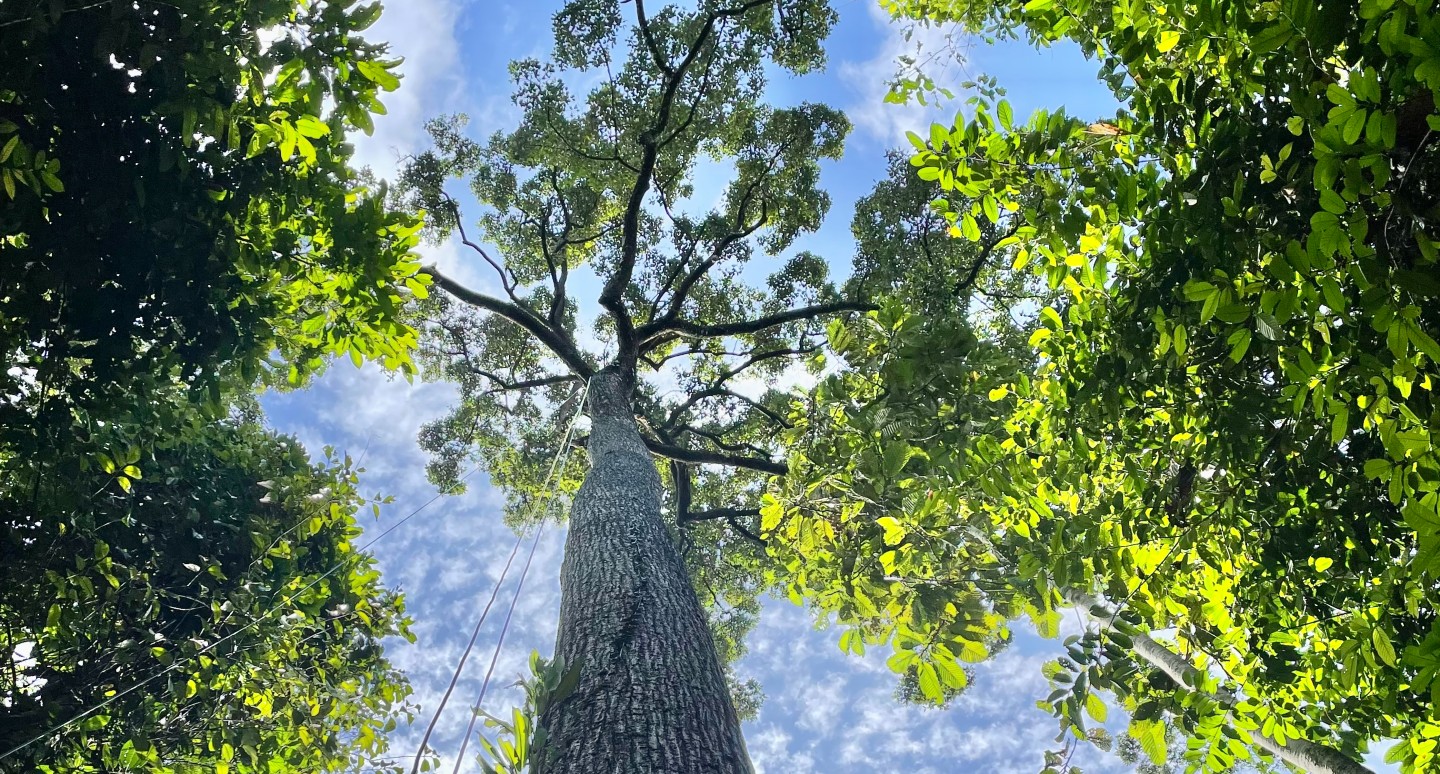
Recent research confirms that giant trees can efficiently pump water to their top branches. The discussion includes reactions to the findings and questions about tree physiology.
What the discussion says
- Some commenters express amusement and support for the research.
- Others note that the findings seem obvious or question the methodology.
- A few discuss the biological mechanisms and implications for plant science.
“Another paper for the “Obviously” category.”
“The root cause is nailed down (not a theory anymore).”
Comments
Hacker News
by alldayhaterdude
by lukeholder
by kank0de
by yubblegum
by huijzer
by jzer0cool
by luxuryballs
by cwmoore
It seems that trees just don't grow that tall anymore. Even common trees such as the spruce seem to be able to reach 100m, they just kind of don't.
One possibility is the depletion of nutrients. But what I think is to blame is the lack of elephants. They constantly ruined young trees and the lucky few that survived then grew huge. Perhaps the redwoods were actually created by the natives, who removed young trees, and kept the old trees standing.
by accidentallfact
I suppose that’s not particularly relevant for more recent old growth tall trees that seem to have got by fine in a colder Earth.
But it’s easy to imagine a warmer, wetter, Earth with higher atmospheric CO2 concentrations being more conducive to taller tree growth.
On the other hand, I probably don’t really know what I’m talking about, not my area of expertise.
by tryagainian
That would work, but it's not how to works apparently. According to this veritasium video, it's because of "negative pressure" aka tension.
https://www.youtube.com/watch?v=BickMFHAZR0
I recommend watching, I think it's one of the best veritasium Dereck has ever produced.
by bnegreve
While admittedly contested and only reproduced by a few labs outside Gerald Pollack's at University of Washington, there is a solid case that it could play a role in transporting water and sap to the tops of trees. At least, it's involved in the motion induced in hydrophilic tubes when there is sufficient ambient radiant energy (uv/infrared).
Relevant papers:
"Exclusion-zone water inside and outside of plant xylem vessels." 2024 Scientific Reports. https://www.nature.com/articles/s41598-024-62983-3
"Surface-induced flow: a natural microscopic engine using infrared energy as fuel." 202 Science Advances. https://www.science.org/doi/10.1126/sciadv.aba0941
"Long-range forces extending from polymer-gel surfaces." 2003 Phys. Rev. E. https://link.aps.org/doi/10.1103/PhysRevE.68.031408
Pollack's site: https://www.pollacklab.org/
Some critiques of Pollack's theory:
Schurr, J.M. (2013). Phenomena associated with gel–water interfaces: analyses and alternatives to the long-range ordered water hypothesis. J. Phys. Chem. B, 117(25), 7653–7674. https://doi.org/10.1021/jp302589y Elton, D.C., Spencer, P.D., Riches, J.D. & Williams, E.D. (2020). Exclusion zone phenomena in water — a critical review of experimental findings and theories. Int. J. Mol. Sci., 21(14), 5041. https://doi.org/10.3390/ijms21145041 (open access; the most thorough critical review) Elton, D.C. & Spencer, P.D. (2021). Pathological water science — four examples and what they have in common. In Water in Biomechanical and Related Systems (Biologically-Inspired Systems, vol. 17), pp. 155–170. Springer. https://doi.org/10.1007/978-3-030-67227-0_8 (preprint: https://arxiv.org/abs/2010.07287)
by pkghost
Yours shall be filed under homeopathy :)
by theendisney
Coalescence of coastal fog accounts for a considerable part of the trees' water needs.[23]
https://en.wikipedia.org/wiki/Sequoia_sempervirens#Fog_and_f...
by m463
by hinkley
[1] https://www.sfgate.com/science/article/REDWOODS-How-tall-can...
by nomel
by efskap
A bucket brigade works just as well up ten flights of stairs as up one hundred. So does a system of opening and closing valves.
We can pump water from a bucket on one floor of building to a bucket on the next floor easily. Then we can repeat the same thing at the next floor; the pressure from the numerous floors above doesn't factor in because there isn't a connected water column.
by kazinator
Hm, may be because they are not really "pumping" the water?
by nullorempty
by leni536
Too bad we cut it down, along with almost every other giant Douglas-fir.
by calibas
We're lucky to have a handful of big Doug Firs, Sitka Spruce, and Western Red Cedars left on Vancouver Island.
by seabrookmx
For a while there were people poaching the moss that facilitated this, which is a problem because it grows only inches per year.
by hinkley
"The placard recorded that the Nooksack tree produced 96,345 board feet (227.348 cubic meters) of the "finest quality" lumber.
The New York Times regarded the tree in a March 7, 1897 issue as the "most magnificent fir tree ever beheld by human eyes" and called its destruction a "truly pitiable tale" and a "crime".
The Morning Times of February 28, 1897 claimed that the wood, sawed into one-inch strips, would reach from "Whatcom [the tree's location] to China"."
by Alien1Being
by chasil
by Minor49er
[1] https://www.sfgate.com/science/article/REDWOODS-How-tall-can...
by nomel
by cortesoft
by fc417fc802
This sentence undersells the phenomenon quite a bit: the “extreme low pressure” is in fact several bars of negative pressure and the challenge of maintaining water in liquid form is avoiding cavitation.
I was exposed to the physics of trees though the entrance exam to École Polytechnique (France's best University) and it's been carved in my mind since then: http://alainrobichon.free.fr/Concours/X_PC_PH1_01.pdf
AFAIK students are still being given this masterpiece for practice even though it's now 25 years old.
by stymaar
Join the discussion
Write your take first — we'll ask for email only when you're ready to publish.
- Hacker News
- Happy for them.by alldayhaterdude
- This made me laugh out loud. Thanks.by lukeholder
- plants are very brave, both metaphorically and physically.by kank0de
- Rather tenacious and unrelenting than brave. Many of them wear war paint, employ chemical warfare, and dress up in scary getups to scare away potential enemies/predators. Effective for sure, but "brave"?by yubblegum
- Another paper for the “Obviously” category. Otherwise the leafs at the top would be brown. But I did a PhD myself and our papers were exactly the same. Noone wants to rock the boat. Professors just want to get to their pension without problems. And people will cite things that are in line with their own stuff. So there you have it. Just proving the obvious time and time and time again.by huijzer
- Any truth to whether water pumped by tree (branches) is potable?by jzer0cool
- I’m glad to find the trees are doing well, even the big ones, that managed to grow big... ???by luxuryballs
- “The root cause is nailed down (not a theory anymore)…” —Claudeby cwmoore
- I don't get why it is believed that trees can't pump water above a certain limit, all it should take is a system of valves, something that plants already have for other purposes. It certainly isn't lumuted by trees literally sucking water up as that would limit them to a height that can be easily exceeded by the majority of trees.
It seems that trees just don't grow that tall anymore. Even common trees such as the spruce seem to be able to reach 100m, they just kind of don't.
One possibility is the depletion of nutrients. But what I think is to blame is the lack of elephants. They constantly ruined young trees and the lucky few that survived then grew huge. Perhaps the redwoods were actually created by the natives, who removed young trees, and kept the old trees standing.
by accidentallfact - Also, wasn’t the 250 ppm atmospheric CO2 concentration prior to the start of the Industrial Revolution a historic low as far a geological-time goes?
I suppose that’s not particularly relevant for more recent old growth tall trees that seem to have got by fine in a colder Earth.
But it’s easy to imagine a warmer, wetter, Earth with higher atmospheric CO2 concentrations being more conducive to taller tree growth.
On the other hand, I probably don’t really know what I’m talking about, not my area of expertise.
by tryagainian - > all it should take is a system of valves,
That would work, but it's not how to works apparently. According to this veritasium video, it's because of "negative pressure" aka tension.
https://www.youtube.com/watch?v=BickMFHAZR0
I recommend watching, I think it's one of the best veritasium Dereck has ever produced.
by bnegreve - Folks still sleeping on structured water.
While admittedly contested and only reproduced by a few labs outside Gerald Pollack's at University of Washington, there is a solid case that it could play a role in transporting water and sap to the tops of trees. At least, it's involved in the motion induced in hydrophilic tubes when there is sufficient ambient radiant energy (uv/infrared).
Relevant papers:
"Exclusion-zone water inside and outside of plant xylem vessels." 2024 Scientific Reports. https://www.nature.com/articles/s41598-024-62983-3
"Surface-induced flow: a natural microscopic engine using infrared energy as fuel." 202 Science Advances. https://www.science.org/doi/10.1126/sciadv.aba0941
"Long-range forces extending from polymer-gel surfaces." 2003 Phys. Rev. E. https://link.aps.org/doi/10.1103/PhysRevE.68.031408
Pollack's site: https://www.pollacklab.org/
Some critiques of Pollack's theory:
Schurr, J.M. (2013). Phenomena associated with gel–water interfaces: analyses and alternatives to the long-range ordered water hypothesis. J. Phys. Chem. B, 117(25), 7653–7674. https://doi.org/10.1021/jp302589y Elton, D.C., Spencer, P.D., Riches, J.D. & Williams, E.D. (2020). Exclusion zone phenomena in water — a critical review of experimental findings and theories. Int. J. Mol. Sci., 21(14), 5041. https://doi.org/10.3390/ijms21145041 (open access; the most thorough critical review) Elton, D.C. & Spencer, P.D. (2021). Pathological water science — four examples and what they have in common. In Water in Biomechanical and Related Systems (Biologically-Inspired Systems, vol. 17), pp. 155–170. Springer. https://doi.org/10.1007/978-3-030-67227-0_8 (preprint: https://arxiv.org/abs/2010.07287)
by pkghost - I regretably didnt save it but there was a truly hilarious topic on usenet sci.physics long long ago. If we've gathered enough evidence against something or if the thing goes against accepted consensus you are forbidden from doing further research and new evidence is no longer allowed. The topic then invited others to list such topics. The list grew to hundreds of entries and people couldnt resist getting angry reading their personal trigger words despite there being many more silly things on it.
Yours shall be filed under homeopathy :)
by theendisney - on the other hand, many giant trees get the water out of the air via fog:
Coalescence of coastal fog accounts for a considerable part of the trees' water needs.[23]
https://en.wikipedia.org/wiki/Sequoia_sempervirens#Fog_and_f...
by m463 - There’s also a theory that the moss on these trees is mutualism instead of simply epiphytic. The moss holds moisture, which can be accessed by the tree.by hinkley
- Sequoia are still limited in height by gravity, probably due to capillary pressures. [1] If they evolved to be segmented, they could probably do it.
[1] https://www.sfgate.com/science/article/REDWOODS-How-tall-can...
by nomel - Similarly, it blows my mind that all trees are made of air, specifically the carbon in it. I used to think that the biomass must come from the soil, but reality is more interesting.by efskap
- I would not even expect there to be a problem; it only seems that way if you naively imagine that trees contain continuous, open pipes from top top bottom.
A bucket brigade works just as well up ten flights of stairs as up one hundred. So does a system of opening and closing valves.
We can pump water from a bucket on one floor of building to a bucket on the next floor easily. Then we can repeat the same thing at the next floor; the pressure from the numerous floors above doesn't factor in because there isn't a connected water column.
by kazinator - >Giant trees have no trouble pumping water to top branches
Hm, may be because they are not really "pumping" the water?
by nullorempty - What would you call it?by leni536
- The largest tree on record is rejected in part because it's over the theoretical limit: https://en.wikipedia.org/wiki/Nooksack_Giant
Too bad we cut it down, along with almost every other giant Douglas-fir.
by calibas - I just visited this beauty[1] a few weeks ago. Not 400ft tall, but over half that and over 13ft round at the base!
We're lucky to have a handful of big Doug Firs, Sitka Spruce, and Western Red Cedars left on Vancouver Island.
by seabrookmx - There are stories that the moss on trees in temperate rainforests allow the tree to pull water from their branches instead of the ground, increasing their max height.
For a while there were people poaching the moss that facilitated this, which is a problem because it grows only inches per year.
by hinkley - Human barbarism is not new...
"The placard recorded that the Nooksack tree produced 96,345 board feet (227.348 cubic meters) of the "finest quality" lumber.
The New York Times regarded the tree in a March 7, 1897 issue as the "most magnificent fir tree ever beheld by human eyes" and called its destruction a "truly pitiable tale" and a "crime".
The Morning Times of February 28, 1897 claimed that the wood, sawed into one-inch strips, would reach from "Whatcom [the tree's location] to China"."
by Alien1Being - Kurzgesagt has two videos on trees addressing this and other questions.by chasil
- I'd be careful suggesting Kurzgesagt because they push propaganda for large corporationsby Minor49er
- This goes against all previous research/measurements for actually tall trees (looks like they only considered up to 80m) and the fact that there are exactly zeros trees in the world taller than 130 meters [1]. Wide capillaries at the base, like stated in the article, don't seem to be related.
[1] https://www.sfgate.com/science/article/REDWOODS-How-tall-can...
by nomel - Couldn't both things be true? Water transport is not the limiting factor, but some other thing is?by cortesoft
- I agree it doesn't pass the sniff test (where are the 500 meter trees in the rainforests?) but I think it would make an excellent goal for molecularbiological and genetic engineering. We (our civilization) need to become much more skilled at that before we start editing the human germline, and we will inevitably want to edit the human germline eventually (or rather we are currently exhibiting great restraint in not doing so but I'm not sure how much longer that will last), and anyway thousand meter trees just sound like they would be really cool.by fc417fc802
- > These vessels have evolved intricate adaptations that can maintain the water in liquid form, even under the extreme low pressures
This sentence undersells the phenomenon quite a bit: the “extreme low pressure” is in fact several bars of negative pressure and the challenge of maintaining water in liquid form is avoiding cavitation.
I was exposed to the physics of trees though the entrance exam to École Polytechnique (France's best University) and it's been carved in my mind since then: http://alainrobichon.free.fr/Concours/X_PC_PH1_01.pdf
AFAIK students are still being given this masterpiece for practice even though it's now 25 years old.
by stymaar
Related stories
Ants: Who looks after the injured in a colony?
uni-wuerzburg.de · 9 points · 1 comments
Reform UK leader 'in real trouble' against Count Binface
mirror.co.uk · 32 points · 19 comments
Decoding the obfuscated bash script on a Uniqlo t-shirt
tris.sherliker.net · 1063 points · 181 comments
StreetComplete: Fixing OpenStreetMap, one tiny quest at a time
streetcomplete.app · 761 points · 182 comments
Every new car sold in the European Union must include a driver monitoring camera
allaboutcookies.org · 736 points · 969 comments
Chat Control 1.0 and 2.0 Explained
fightchatcontrol.eu · 645 points · 238 comments