
Discussion summary
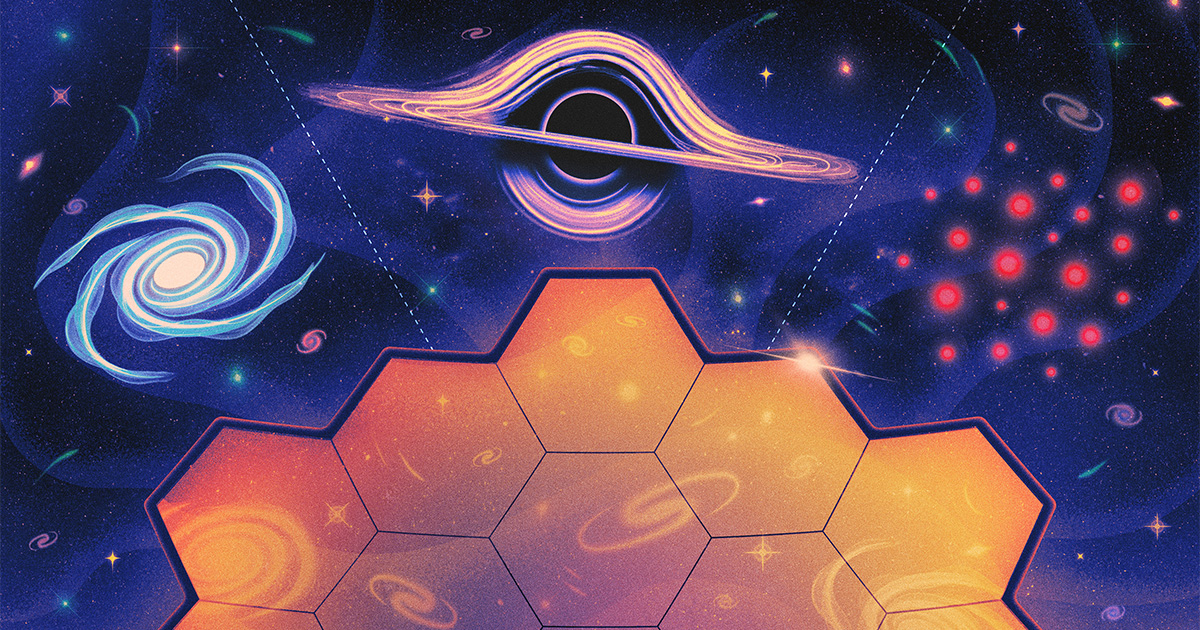
Astrophysicists are debating the implications of Webb telescope observations that challenge existing models of early black holes and galaxies. Discussions include the scientific process, the nature of truth, and the potential for new theories.
What the discussion says
- Some argue the observations require new theories to explain early black holes and galaxies.
- Others criticize the focus on philosophical debates over scientific progress.
- There is skepticism about the accuracy and interpretation of data from sources like Quanta magazine.
“Science is about creating and selecting more predictive models.”
“The Big Bang isn't a theory about how the universe began.”
Comments
Hacker News
This subtitle really bothers me. Science isn't about finding out what is true. Science is about finding out what is false and building models to explain the rest. We can never confidently say we know something to be true because that closes the door for future science to disprove our beliefs and that's exactly the purpose of science.
The best we can do is come up with increasingly more useful models accepting that in the end all models are wrong but different models are useful for different purposes.
by phyzix5761
by idiotsecant
by Tanath
But what about the why? Why do we seek ever more predictive models? Obviously more predictive models allow us to just... do more and better things. And I think it's fair to say that that's enough justification in itself. But is there no substance behind the idea that we seek ever more predictive models because we believe it to be a (perhaps the only) systemic way towards "the truth"?
Put in other words, do you actually believe that there is no room for truth in science? Just concurrence and agreement with observation?
I guess I'm just nitpicking on your use of the phrase "science is about". I do agree that perhaps a better subtitle (without needing to reach for contortions in language) would be "which ones are more true".
by icegreentea2
"True" has a connotation of absoluteness and finality. But I doubt humanity can ever know what is "true" about the universe. We can only model its phenomena with better theories, where "better" is always a temporary badge conferred for its prediction power and degree of agreement with known observations. Until an even "better" theory is figured out.
"Now they just need to figure out which ones are _better_"
by lovelearning
by johngossman
by theodorejb
by mejari
The data found doesn't contradict the big bang in any shape or form. It does challenge beliefs around black hole formation.
The reason for the big bang model is because based on all our measurements of all the visible universe, it appears that everything is spreading out. Any new model needs to explain why it is the universe appears to be spreading out.
There's not a scientist alive that wouldn't like to discover that "actually a fundamental principle about my field of study is completely wrong". But that takes hard work, evidence, and models which better fit than the previous ones did. You need to find something that can't be explained with the old model and can only be explained with the new model.
by cogman10
Take it with a grain of salt, and know for sure its leaving out a huge range of scientists views.
by xqcgrek2
--1-- Charlotte Mason (not, so far as I can tell, affiliated with or funded by the Simons Foundation)
of the Cosmic Dawn Center (not, so far as I can tell, affiliated with or funded by the Simons Foundation)
which is associated with the Niels Bohr Institute at the University of Copenhagen (not, so far as I can tell, affiliated with or funded by the Simons Foundation, except that the NBI hosts something called the "Niels Bohr International Academy" that has taken money from the Simons Foundation; it doesn't look to me as if Charlotte Mason has any connection with this)
and also with the National Space Institute at the Technical University of Denmark (not, so far as I can tell, affiliated with or funded by the Simons Foundation)
--2-- The James Webb Space Telescope (not, so far as I can tell, affiliated with or funded by the Simons Foundation)
--3-- Jenny Greene (not, so far as I can tell, affiliated with or funded by the Simons Foundation, though she did once give a talk at the Center For Computational Astrophysics at the Flatiron Institute which is part of the Simons Foundation)
of Princeton University (not, so far as I can tell, affiliated with the Simons Foundation though I expect it's taken some of their money, but in any case no one needs an excuse for reporting on work done at Princeton)
--4-- Unnamed-in-the-article researchers who found that a "little red dot" is likely a supermassive black hole without stars around it; the Simons Foundation is not mentioned anywhere in the paper they published about this; neither the first-named author of that paper nor the one quoted in the linked article has obvious Simons connections, and both are at the University of Cambridge which, again, no one needs an excuse for reporting on the doings of.
--5-- Rachel Sommerville of the Flatiron Institute. Here there really is a Simons connection; the Flatiron Institute is part of the Simons Foundation. It does computational research in scientific fields, astrophysics being one of them.
--6-- "a meeting in April 2026 in Helsingør, Denmark" about the early universe; this was titled "Charting Cosmic Dawn in Copenhagen" and so far as I can tell has no Simons connection other than the fact that two of the 21 people listed as "invited speakers and tutorial leads" are from the Flatiron Institute, which seems innocuous since the F.I. does in fact do scientific research in this area.
--7-- Hakim Atek (no Simons connection so far as I can see)
of the Paris Institute of Astrophysics (no Simons connection so far as I can see, though I did find evidence that at least once the Simons Foundation has provided funding for a person working there)
of the Sorbonne University (not affiliated with the Simons Foundation; I'm sure they sometimes take S.F. money but, yet again, this is not an institution that anyone needs excuses to report on the work of)
So, I find one, count 'em, one, instance of a Simons-associated entity in the article. How very sinister of Quanta to mention them and hide their own affiliation. Oh, wait: "Editor’s note: The Flatiron Institute is funded by the Simons Foundation, which also funds this editorially independent magazine. Simons Foundation funding decisions have no influence on our coverage."
You may, of course, choose not to believe that last claim. You might be right. But in this article I don't see any obvious sign of bias; they reported on a whole lot of things most of which have no particular connections with the Simons Foundation, and the one S.F.-affiliated thing they reported on does seem relevant. I can't rule out the possibility that Sommerville's work is actually bad and was reported on here only because of the Simons connection, but e.g. she is one of those invited contributors to that conference in Copenhagen which doesn't seem to have had a Simons connection and does seem to have been run by reputable astrophysicists.
by gjm11
by dvh
by deadbabe
by beng-nl
by CrzyLngPwd
what makes us so certain that we can trust what we see on James Webb? Can we definitely discard a measurement problem?
by 6thbit
by BurningFrog
I vouched for your two posts in this thread, but that never works, and honestly it gets a little old trying to pick up the slack left by HN's inscrutable, unaccountable, and largely-broken filter. This has been happening a lot lately, unfortunately.
by CamperBob2
Messing up the data analysis has major precedents. If you aren't familiar you should look into BICEP data in 2014, they thought they had observed primordial gravitational waves which would have been earth shattering. Instead they just messed up the dust correction pipeline. I don't envy the day they came to that realization. I was in several conference rooms at Princeton where BICEP people presented their analysis and David Spergel (of WMAP, previous head of the department at princeton) and others were able to walk them through how they thought they had kind of messed things up. This is what routinely happens, ESPECIALLY when something unexpected is observed. Every possible explanation is looked into, and ESPECIALLY in cosmology, you can do that incredibly well. Cosmology is one of the most beautiful sciences in my experience, precisely because we have such good ways to model the observations to probe various models, and you can treat the observations with Bayesian stats with virtually no risk of misspecifying your model, or, if you do find its misspecified, you have discovered something new about the universe.
The process to go from raw observations to physics, correcting for all the crap in between early universe light and us (dust which also rotates light polarization -- this explained the BICEP issue, instrument systematics which are measured to incredible precision on the ground (e.g. point spread function -- what is the detector response to various intensities of light; e.g. you get electrons for bright sources that spill into neighboring pixels)
Everyone everywhere is looking to make a name for themselves by discovering the discrepancy -- be it a screwup of some other team (astro community is generally very supportive and positive but also competitive) or a problem with simulation assumptions, a genuine discrepancy in our understanding of the universe (i.e. the tension in the hubble constant -- you infer rate of expansion from cosmic background radiation / early universe observations, and then try it using an alternative method -- using local variable stars, and you get a statistically significant difference).
So I would say: if there's a screwup it will be found, and a genuine fuckup is possible and does happen, but when it does believe me we will know usually within a few months. You'll have a ton of people trying to reproduce the results, pouring over everything there is that could possibly explain these observations. The wheel of astrophysics grinds slowly but it grinds finely.
Edit: also shoutout to Jenny Greene -- one of the world's foremost experts on galactic astronomy and also a genuinely great person. She rented me her house for a summer for dirt cheap when I was a poor grad student with nowhere to stay. Also hosted the best graduate student parties (our idea of a party is beer and board games and complaining about our advisers)
by astro1234
by rhesa
by neffy
We can trust what we see. We can't trust there's nothing where we don't see anything.
by scotty79
by tgarrett
For the red dot observations, I believe this things have been measured by at least 3 of the 4 devices on board - NIRCam (near infrared camera, has very limited spectral capabilities through its filter wheel), NIRSpec (near infrared spectrograph) and MIRI (mid infrared instrument).
I cannot pretend to have the actual expertise, but it does seem vanishingly unlikely that all 3 instruments could create consistent artefacts in the same location.
by icegreentea2
by allcentury
by analog31
https://en.wikipedia.org/wiki/Messier_87#Supermassive_black_...
by tgarrett
It’s like a Dunning-Kruger effect on a field-wide scale, but in a good way. Rather than an example of hubris, it’s an opportunity for awe.
by gbjcantab
It does present a weird science communication problem. After the first generation, scientists are all focused on "little effects" and don't get excited about talking about the big effects any more. They like talking about what they're working on (little effects). Textbooks drift from fundamentals and new entrants and outsiders get a distorted view of reality.
by paytonjjones
by chickensong
Join the discussion
Write your take first — we'll ask for email only when you're ready to publish.
- Hacker News
- > Faced with observations of early black holes and galaxies that weren’t expected to exist, scientists have come up with a wealth of new theories to explain them. Now they just need to figure out which ones are true.
This subtitle really bothers me. Science isn't about finding out what is true. Science is about finding out what is false and building models to explain the rest. We can never confidently say we know something to be true because that closes the door for future science to disprove our beliefs and that's exactly the purpose of science.
The best we can do is come up with increasingly more useful models accepting that in the end all models are wrong but different models are useful for different purposes.
by phyzix5761 - Oh God do we really have to have the pedantic 5 page navel gazing thread about the philosophy of science that ultimately accomplishes nothing other than slightly increasing the entropy of the universeby idiotsecant
- Hypotheses are made for a reason though. Science is still about finding what's true, and ruling out what's not is part of the process/method for doing so. Sometimes all the alternatives to the truth are ruled out and we know the truth. Scientific revolutions happen sometimes, but they still need to explain everything the old theories explained. The newer theories may still be wrong, but in different and hopefully fewer ways. It's important to keep the scope of what's been demonstrated/tested in mind to not be misled about what truths have been established. Newton's physics is still largely true within the scope of everyday experience, for example.by Tanath
- I think it's very fair to say that the mechanics of science is about creating and selecting ever more predictive models that explain observations. So that's the how and what.
But what about the why? Why do we seek ever more predictive models? Obviously more predictive models allow us to just... do more and better things. And I think it's fair to say that that's enough justification in itself. But is there no substance behind the idea that we seek ever more predictive models because we believe it to be a (perhaps the only) systemic way towards "the truth"?
Put in other words, do you actually believe that there is no room for truth in science? Just concurrence and agreement with observation?
I guess I'm just nitpicking on your use of the phrase "science is about". I do agree that perhaps a better subtitle (without needing to reach for contortions in language) would be "which ones are more true".
by icegreentea2 - I agree with you.
"True" has a connotation of absoluteness and finality. But I doubt humanity can ever know what is "true" about the universe. We can only model its phenomena with better theories, where "better" is always a temporary badge conferred for its prediction power and degree of agreement with known observations. Until an even "better" theory is figured out.
"Now they just need to figure out which ones are _better_"
by lovelearning - I think you are confusing the scientific process, in particular Popper's falsification principle, with science's purpose, which is to find the truth, or at least sort things into true and false. It's a bit like saying the purpose of programming is to have a bunch of unit tests.by johngossman
- Instead of questioning whether the Big Bang assumption is true, astrophysicists prefer to perform endless "gymnastics" to try to make the mounting contrary data fit their theory about how the universe began.by theodorejb
- The big bang isn't a theory about how the universe began, so I think you have a fundamental misunderstanding of these topics.by mejari
- Are you kidding? An astrophysicist that could come up with a new model that explains the current data would win a Nobel prize and earth shattering levels of notoriety.
The data found doesn't contradict the big bang in any shape or form. It does challenge beliefs around black hole formation.
The reason for the big bang model is because based on all our measurements of all the visible universe, it appears that everything is spreading out. Any new model needs to explain why it is the universe appears to be spreading out.
There's not a scientist alive that wouldn't like to discover that "actually a fundamental principle about my field of study is completely wrong". But that takes hard work, evidence, and models which better fit than the previous ones did. You need to find something that can't be explained with the old model and can only be explained with the new model.
by cogman10 - Quanta magazine is a glorified university press release and marketing shop for Simons associated institutions.
Take it with a grain of salt, and know for sure its leaving out a huge range of scientists views.
by xqcgrek2 - The institutions, projects and individuals named in the article are, in order of appearance:
--1-- Charlotte Mason (not, so far as I can tell, affiliated with or funded by the Simons Foundation)
of the Cosmic Dawn Center (not, so far as I can tell, affiliated with or funded by the Simons Foundation)
which is associated with the Niels Bohr Institute at the University of Copenhagen (not, so far as I can tell, affiliated with or funded by the Simons Foundation, except that the NBI hosts something called the "Niels Bohr International Academy" that has taken money from the Simons Foundation; it doesn't look to me as if Charlotte Mason has any connection with this)
and also with the National Space Institute at the Technical University of Denmark (not, so far as I can tell, affiliated with or funded by the Simons Foundation)
--2-- The James Webb Space Telescope (not, so far as I can tell, affiliated with or funded by the Simons Foundation)
--3-- Jenny Greene (not, so far as I can tell, affiliated with or funded by the Simons Foundation, though she did once give a talk at the Center For Computational Astrophysics at the Flatiron Institute which is part of the Simons Foundation)
of Princeton University (not, so far as I can tell, affiliated with the Simons Foundation though I expect it's taken some of their money, but in any case no one needs an excuse for reporting on work done at Princeton)
--4-- Unnamed-in-the-article researchers who found that a "little red dot" is likely a supermassive black hole without stars around it; the Simons Foundation is not mentioned anywhere in the paper they published about this; neither the first-named author of that paper nor the one quoted in the linked article has obvious Simons connections, and both are at the University of Cambridge which, again, no one needs an excuse for reporting on the doings of.
--5-- Rachel Sommerville of the Flatiron Institute. Here there really is a Simons connection; the Flatiron Institute is part of the Simons Foundation. It does computational research in scientific fields, astrophysics being one of them.
--6-- "a meeting in April 2026 in Helsingør, Denmark" about the early universe; this was titled "Charting Cosmic Dawn in Copenhagen" and so far as I can tell has no Simons connection other than the fact that two of the 21 people listed as "invited speakers and tutorial leads" are from the Flatiron Institute, which seems innocuous since the F.I. does in fact do scientific research in this area.
--7-- Hakim Atek (no Simons connection so far as I can see)
of the Paris Institute of Astrophysics (no Simons connection so far as I can see, though I did find evidence that at least once the Simons Foundation has provided funding for a person working there)
of the Sorbonne University (not affiliated with the Simons Foundation; I'm sure they sometimes take S.F. money but, yet again, this is not an institution that anyone needs excuses to report on the work of)
So, I find one, count 'em, one, instance of a Simons-associated entity in the article. How very sinister of Quanta to mention them and hide their own affiliation. Oh, wait: "Editor’s note: The Flatiron Institute is funded by the Simons Foundation, which also funds this editorially independent magazine. Simons Foundation funding decisions have no influence on our coverage."
You may, of course, choose not to believe that last claim. You might be right. But in this article I don't see any obvious sign of bias; they reported on a whole lot of things most of which have no particular connections with the Simons Foundation, and the one S.F.-affiliated thing they reported on does seem relevant. I can't rule out the possibility that Sommerville's work is actually bad and was reported on here only because of the Simons connection, but e.g. she is one of those invited contributors to that conference in Copenhagen which doesn't seem to have had a Simons connection and does seem to have been run by reputable astrophysicists.
by gjm11 - Only two things are infinite: the cosmos, and a web designer’s obsession with discovering new ways to break scrolling.by dvh
- "Virgil led Dante into the next layer of hell, past the lecherers, the murderers, the thieves... 'And here,' he said 'is where we keep the web designers who break scrolling'"by deadbabe
- And we’re not sure about the cosmos.by beng-nl
- And no one can be sure about the cosmos :-pby CrzyLngPwd
- That’s a beautiful article showcasing our predicament in having access to more information about the universe. Now i have to be the one to ask the dumb defensive question:
what makes us so certain that we can trust what we see on James Webb? Can we definitely discard a measurement problem?
by 6thbit - This is one reason to dislike the NASA process of building one huge prestige telescope every few decades.by BurningFrog
- astro1234, your account is dead for some reason - you might consider emailing the admins.
I vouched for your two posts in this thread, but that never works, and honestly it gets a little old trying to pick up the slack left by HN's inscrutable, unaccountable, and largely-broken filter. This has been happening a lot lately, unfortunately.
by CamperBob2 - Not a dumb defensive question but you should know the nice thing about these experiments is the incredible amount of work that goes into calibration and understanding all error signals.
Messing up the data analysis has major precedents. If you aren't familiar you should look into BICEP data in 2014, they thought they had observed primordial gravitational waves which would have been earth shattering. Instead they just messed up the dust correction pipeline. I don't envy the day they came to that realization. I was in several conference rooms at Princeton where BICEP people presented their analysis and David Spergel (of WMAP, previous head of the department at princeton) and others were able to walk them through how they thought they had kind of messed things up. This is what routinely happens, ESPECIALLY when something unexpected is observed. Every possible explanation is looked into, and ESPECIALLY in cosmology, you can do that incredibly well. Cosmology is one of the most beautiful sciences in my experience, precisely because we have such good ways to model the observations to probe various models, and you can treat the observations with Bayesian stats with virtually no risk of misspecifying your model, or, if you do find its misspecified, you have discovered something new about the universe.
The process to go from raw observations to physics, correcting for all the crap in between early universe light and us (dust which also rotates light polarization -- this explained the BICEP issue, instrument systematics which are measured to incredible precision on the ground (e.g. point spread function -- what is the detector response to various intensities of light; e.g. you get electrons for bright sources that spill into neighboring pixels)
Everyone everywhere is looking to make a name for themselves by discovering the discrepancy -- be it a screwup of some other team (astro community is generally very supportive and positive but also competitive) or a problem with simulation assumptions, a genuine discrepancy in our understanding of the universe (i.e. the tension in the hubble constant -- you infer rate of expansion from cosmic background radiation / early universe observations, and then try it using an alternative method -- using local variable stars, and you get a statistically significant difference).
So I would say: if there's a screwup it will be found, and a genuine fuckup is possible and does happen, but when it does believe me we will know usually within a few months. You'll have a ton of people trying to reproduce the results, pouring over everything there is that could possibly explain these observations. The wheel of astrophysics grinds slowly but it grinds finely.
Edit: also shoutout to Jenny Greene -- one of the world's foremost experts on galactic astronomy and also a genuinely great person. She rented me her house for a summer for dirt cheap when I was a poor grad student with nowhere to stay. Also hosted the best graduate student parties (our idea of a party is beer and board games and complaining about our advisers)
by astro1234 - Have a look at David Kipping's video on Cool Worlds: https://www.youtube.com/watch?v=QCKrUZeiTJo . It goes into a bit of detail on compensating for systemic issues in JWST.by rhesa
- Some of the Hubble results were also raising questions. At the same time, I read one of the papers on the galaxy stuff, and what struck me was they were identifying galaxy shapes by counting the pixels each galaxy had, so there are definitely some question marks over how they do some of this.by neffy
- > what makes us so certain that we can trust what we see on James Webb?
We can trust what we see. We can't trust there's nothing where we don't see anything.
by scotty79 - If you're worried about bad pixels or noise, it seems like there is an easy fix: point it in a direction specified by some angles theta & phi, wait long enough to accumulate light from distant faint objects (high redshift galaxies etc), then shift Webb's orientation by a small amount to theta+delta_1 & phi+delta_2, which will have a significant overlap with the original image, and after taking the 2nd image check to make sure that all the objects have shifted over together by the same amount...by tgarrett
- JWST has 4 different instruments on it. While they all share the same focusing mirrors, but otherwise are 4 different measurement devices.
For the red dot observations, I believe this things have been measured by at least 3 of the 4 devices on board - NIRCam (near infrared camera, has very limited spectral capabilities through its filter wheel), NIRSpec (near infrared spectrograph) and MIRI (mid infrared instrument).
I cannot pretend to have the actual expertise, but it does seem vanishingly unlikely that all 3 instruments could create consistent artefacts in the same location.
by icegreentea2 - Such a fun read, looking forward to moreby allcentury
- So I wonder, where are these giant black holes now? There should be some closer to us than at the edge of the universe, unless something happens to them.by analog31
- The supermassive black hole in the giant elliptical galaxy M87 is merely ~53 million light years away, close enough that we have now imaged it:
https://en.wikipedia.org/wiki/Messier_87#Supermassive_black_...
by tgarrett - This is one of my favorite phenomena: again in again, across various fields of study, breakthroughs in discovery allow us to go from relative ignorance to a level of knowledge and understanding that enables clear and clean conceptual models; then, as we learn even more, we realize how much more complex and weird and multifaceted reality really is.
It’s like a Dunning-Kruger effect on a field-wide scale, but in a good way. Rather than an example of hubris, it’s an opportunity for awe.
by gbjcantab - I think this can be explained by the dictum "big effects get discovered first"
It does present a weird science communication problem. After the first generation, scientists are all focused on "little effects" and don't get excited about talking about the big effects any more. They like talking about what they're working on (little effects). Textbooks drift from fundamentals and new entrants and outsiders get a distorted view of reality.
by paytonjjones - This is almost the same article as https://www.quantamagazine.org/a-single-naked-black-hole-rew...by chickensong
Related stories
Dolosse – a South African invention used over the world
thisbugslife.com · 134 points · 39 comments
The family keeping watch over a 52-year-old pot of soup
wsj.com · 90 points · 71 comments
The Age of Reading Is Over
theatlantic.com · 6 points · 0 comments
Decoding the obfuscated bash script on a Uniqlo t-shirt
tris.sherliker.net · 1072 points · 181 comments
StreetComplete: Fixing OpenStreetMap, one tiny quest at a time
streetcomplete.app · 761 points · 182 comments
Every new car sold in the European Union must include a driver monitoring camera
allaboutcookies.org · 737 points · 969 comments