Discussion summary

A discussion on political bias and polarization in America, focusing on the article's perspective and the role of immigration and partisanship.

What the discussion says

  • Some commenters note the article's bias towards MAGA Republicans.
  • Others argue that good writing is inherently subjective and not neutral.
  • Several mention the historical context of immigration and political corruption.
Good writing is almost never neutral.
ethanplant
The dividing line is the denial itself: the willingness to hold that an election was stolen.
zer0zzz

Comments

Hacker News

Liberals are also assholes, but this article chose to come to a biased conclusion that involves MAGA Republicans.

by jazz9k

“ Republicans who voted for Donald Trump in 2020 and deny the results of that election. The dividing line is the denial itself: the willingness to hold that an election was stolen in the absence of evidence. That single belief turns out to be a genetic marker. Everything else travels with it.”

He doesn’t seem to be talking about conservatives or republicans broadly; seems like he’s focusing on a much smaller minority of people in society with very specific and fringe views. Perhaps it is “bias” to lump these people with the rest of conservatives.

by zer0zzz

I learned that I don't need to agree 100% with an author's premises to find value in what she writes.

She is a bit partisan, but on the other side, it is about time for us on the right to completely re-evaluate MAGA, and go about creating a third way, distinct from the old mainstream republicanism of the McCains and Bushes, but also critical of what MAGA turned out to be.

by elzbardico

“This article reached a conclusion from the author’s perspective” is not a criticism of writing. It is a description of writing.

Good writing is almost never neutral. It can be fair, careful, honest, and proportionate. But if it has nothing to say, it isn’t good writing.

by ethanplant

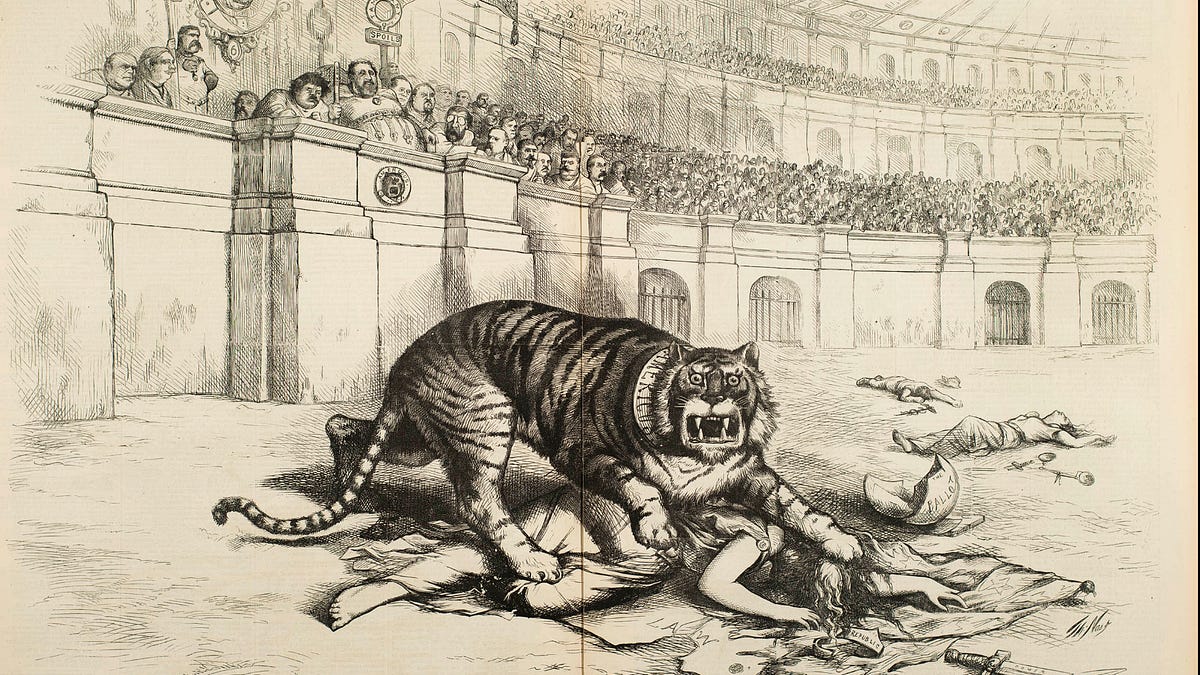
It's remarkable that this article talks about Tammany Hall, Plato, and MAGA, without mentioning the throughline among them: immigration. Tammany Hall’s peak century coincided with mass immigration: https://en.wikipedia.org/wiki/Tammany_Hall.

As Wikipedia explains: "In the 1840s, over 130,000 Irish immigrants arrived in New York City to escape the Great Famine, arriving in poverty and joining scores of thousands of their fellow countrymen who had arrived over the prior decades. By 1855, 34 percent of the city's voter population was composed of Irish immigrants. By providing these new arrivals with patronage employment, job referrals, legal aid, food, shelter, employment insurance, and other extralegal services, including citizenship and naturalization services, Tammany secured the lifelong support of the large and growing Irish population, which would form the majority of its electoral base for the next century. In exchange for these services, the Tammany political machine harvested Irish immigrant votes."

The article also quotes Plato, who predicted Tammany Hall 2,400 years earlier. Plato saw good government as a precarious and fragile thing that could be achieved only through careful cultivation of the polity's "constitution"--not just a legal document, but the political "way of life." As a result, Plato's ideal city had strong borders and was insulated from both trade and immigration: https://spectrum.library.concordia.ca/id/eprint/983154/1/EXO....

"In most states of course, such confusion is a way of life with which people learned to cope by various compromises, as was the case when immigrants are allowed into a country (PS, 293d). But such compromises were neither necessary nor desirable for Plato, since any policy of unrestricted immigration would destroy his political constitution (PL, 736c; 950a). Aristotle agreed that immigration was a dangerous thing because it pitted newcomers against those already established, thus creating tensions and frictions between them."

Plato's Republic describes a society's descent into anarchy as involving the erasure of distinctions between citizens and foreigners: "the metic" (legal permanent resident) "becomes the equal of a citizen and the citizen of a metic, and similarly with the foreigner."

The author sets up an astute point linking Tammany Hall, Plato, and MAGA republicans, but somehow whiffs the conclusion. The U.S. didn’t defeat Tammany Hall through unspecified “fighting back”—it did so through assimilation and homogenization. The U.S. enacted restrictive immigration law in 1921. That, coupled with a population boom, dropped the foreign born population from 15% to under 5% and largely erased the separate identity of Ellis Island immigrants. That neutering of ethnic attachments made it impossible to sustain political machines that were built on ethnic solidarity.

by rayiner

is the author of this post in thread? i do not like the AI voice it reads like.

by rafterydj

That would be disappointing, as the author is a fairly known writer.

by elzbardico

I didn't notice any obvious markers, weird prose, or meandering in this one.

by Cpoll

Join the discussion

Write your take first — we'll ask for email only when you're ready to publish.

  • Hacker News
  • Liberals are also assholes, but this article chose to come to a biased conclusion that involves MAGA Republicans.
    by jazz9k
  • “ Republicans who voted for Donald Trump in 2020 and deny the results of that election. The dividing line is the denial itself: the willingness to hold that an election was stolen in the absence of evidence. That single belief turns out to be a genetic marker. Everything else travels with it.”

    He doesn’t seem to be talking about conservatives or republicans broadly; seems like he’s focusing on a much smaller minority of people in society with very specific and fringe views. Perhaps it is “bias” to lump these people with the rest of conservatives.

    by zer0zzz
  • I learned that I don't need to agree 100% with an author's premises to find value in what she writes.

    She is a bit partisan, but on the other side, it is about time for us on the right to completely re-evaluate MAGA, and go about creating a third way, distinct from the old mainstream republicanism of the McCains and Bushes, but also critical of what MAGA turned out to be.

    by elzbardico
  • “This article reached a conclusion from the author’s perspective” is not a criticism of writing. It is a description of writing.

    Good writing is almost never neutral. It can be fair, careful, honest, and proportionate. But if it has nothing to say, it isn’t good writing.

    by ethanplant
  • It's remarkable that this article talks about Tammany Hall, Plato, and MAGA, without mentioning the throughline among them: immigration. Tammany Hall’s peak century coincided with mass immigration: https://en.wikipedia.org/wiki/Tammany_Hall.

    As Wikipedia explains: "In the 1840s, over 130,000 Irish immigrants arrived in New York City to escape the Great Famine, arriving in poverty and joining scores of thousands of their fellow countrymen who had arrived over the prior decades. By 1855, 34 percent of the city's voter population was composed of Irish immigrants. By providing these new arrivals with patronage employment, job referrals, legal aid, food, shelter, employment insurance, and other extralegal services, including citizenship and naturalization services, Tammany secured the lifelong support of the large and growing Irish population, which would form the majority of its electoral base for the next century. In exchange for these services, the Tammany political machine harvested Irish immigrant votes."

    The article also quotes Plato, who predicted Tammany Hall 2,400 years earlier. Plato saw good government as a precarious and fragile thing that could be achieved only through careful cultivation of the polity's "constitution"--not just a legal document, but the political "way of life." As a result, Plato's ideal city had strong borders and was insulated from both trade and immigration: https://spectrum.library.concordia.ca/id/eprint/983154/1/EXO....

    "In most states of course, such confusion is a way of life with which people learned to cope by various compromises, as was the case when immigrants are allowed into a country (PS, 293d). But such compromises were neither necessary nor desirable for Plato, since any policy of unrestricted immigration would destroy his political constitution (PL, 736c; 950a). Aristotle agreed that immigration was a dangerous thing because it pitted newcomers against those already established, thus creating tensions and frictions between them."

    Plato's Republic describes a society's descent into anarchy as involving the erasure of distinctions between citizens and foreigners: "the metic" (legal permanent resident) "becomes the equal of a citizen and the citizen of a metic, and similarly with the foreigner."

    The author sets up an astute point linking Tammany Hall, Plato, and MAGA republicans, but somehow whiffs the conclusion. The U.S. didn’t defeat Tammany Hall through unspecified “fighting back”—it did so through assimilation and homogenization. The U.S. enacted restrictive immigration law in 1921. That, coupled with a population boom, dropped the foreign born population from 15% to under 5% and largely erased the separate identity of Ellis Island immigrants. That neutering of ethnic attachments made it impossible to sustain political machines that were built on ethnic solidarity.

    by rayiner
  • is the author of this post in thread? i do not like the AI voice it reads like.
    by rafterydj
  • That would be disappointing, as the author is a fairly known writer.
    by elzbardico
  • I didn't notice any obvious markers, weird prose, or meandering in this one.
    by Cpoll

Related stories